Empty cart
Oh no! It appears your cart is empty. Add some almonds to your daily regime with the Treehouse products.
All Blog PostsAlmond Market UpdatesNews

Updated in: August 15, 2026
. • All Blog Posts • News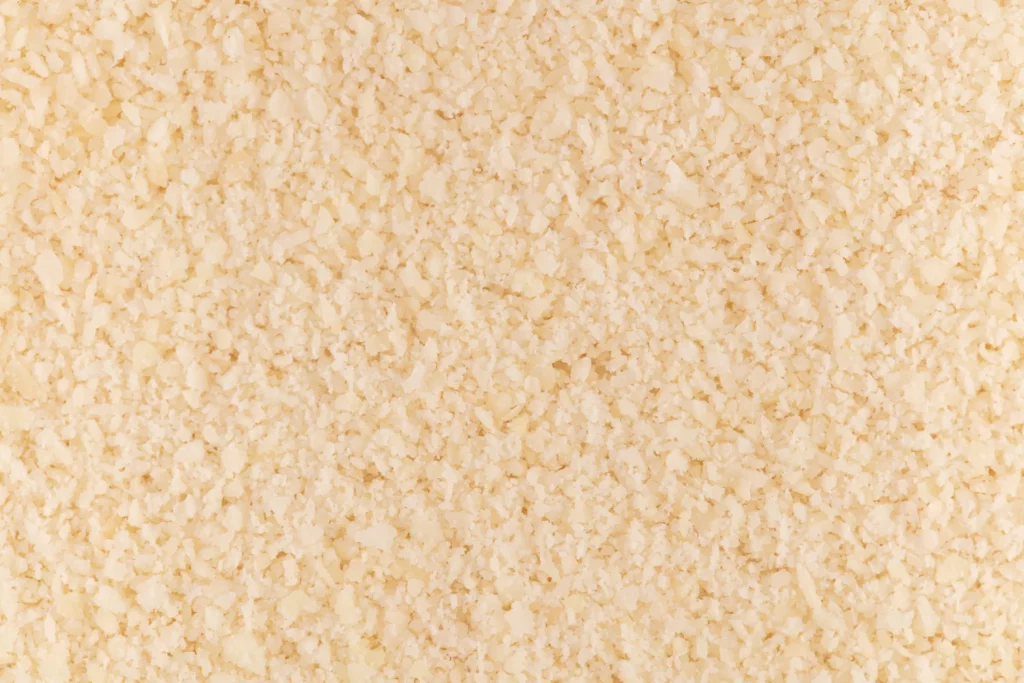
Choosing the right almond flour for industrial use involves more than selecting a commodity ingredient. The type of flour — blanched or natural — and its particle size — fine or coarse — directly impact texture, absorption, shelf life, visual appearance, and formulation compatibility across different food production segments.
In this article, we cover: the functional differences between blanched almond flour and natural almond flour; how granulometry (fine vs. coarse, measured by mesh size) affects performance in industrial applications; which flour type is best suited for each food segment — confectionery, bakery, snacks, gluten-free, and keto products; the nutritional profile that makes almond flour a value-added ingredient; and how Treehouse Almonds’ production process ensures specification consistency and quality at scale.
The most fundamental distinction is whether the almond skin has been removed before grinding. Blanched almond flour is produced from unpeeled almonds — typically processed via hot water or steam to remove the skin — resulting in an ivory color, neutral taste, and finer, more homogeneous particle structure. Natural almond flour (also called almond meal) retains the skin, giving it a light brown color, slightly coarser texture, and a more robust almond flavor.
According to the Almond Board of California, blanched almond flour has a smaller grain size and powdery texture, while almond meal made from unblanched almonds presents a larger grain size, coarser texture, and slightly bitter taste.
For confectionery, macarons, fine pastry, and any application requiring visual purity, blanched is the technical standard. For breadcrumb substitutes, snack coatings, granola bars, and cost-sensitive formulations where a rustic appearance is acceptable, natural almond flour is the right call.
Particle size — measured in industrial specifications by mesh screen — directly determines how almond flour behaves in your process. Treehouse Almonds’ published specification table shows two primary industrial grades:
| Product | Screen Size | Skin Specks | Moisture % | Type |
|---|---|---|---|---|
| Blanched Extra Fine Flour | 20 Mesh | 30 pc / 100 g | < 6% | Blanched |
| Blanched Flour 12M | 12 Mesh | 20 pc / 100 g | < 6% | Blanched |
| Natural Extra Fine Flour | 20 Mesh | N/A | < 6% | Natural |
| Natural Flour 12M | 12 Mesh | N/A | < 6% | Natural |
Extra fine (20 mesh) integrates seamlessly into smooth batters, creams, and liquid systems. It provides uniform moisture absorption and minimal grittiness — essential for macarons, confectionery fillings, keto pasta, and gluten-free baking mixes. Coarse (12 mesh) contributes detectable texture and particle visibility, making it the right choice for snack bars, energy bites, breadcrumb substitutes, granola-style cereals, and any application where a rustic bite is intentional.
Treehouse Almonds also offers a Baking & Cookie Almond Flour — a customizable blend of natural, blanched, conventional, and organic flour at 12 mesh — that allows manufacturers to adjust the balance of flavor, color, texture, and cost across a single production SKU.
Beyond functional performance, almond flour’s nutritional profile is a significant formulation asset. Per quarter-cup serving, it delivers 6g of protein, 3g of dietary fiber, 15g of total fat (primarily monounsaturated), 7mg of Vitamin E, 66mg of calcium, and 75mg of magnesium — nutrients that are often lacking in conventional gluten-free flours. This makes it a natural fit for manufacturers targeting clean-label, high-protein, or nutrient-dense positioning.
One key formulation note: almonds do not contain gluten-forming proteins, so almond flour cannot replicate the structural role of wheat flour on its own. As the Almond Board of California recommends, product developers should use it within blends of gluten-free flours, starches, and gums — substituting roughly one-third of the blend — for optimal moisture, texture, and lift.
Treehouse Almonds has supplied premium almond ingredients to leading food companies for more than 40 years. For almond flour specifically, the key supply advantages are:
For manufacturers who need a specification that doesn’t exist off the shelf, Treehouse’s development teams collaborate directly with customers to create custom flour solutions — adjusting granulometry, base type, and blend ratios to match the exact requirements of each application.
Click here to contact us directly and request your specification sheet.
Be in the loop for vital news about the California almond market.
Enjoy 10% off when you order 6 or more