Empty cart
Oh no! It appears your cart is empty. Add some almonds to your daily regime with the Treehouse products.
All Blog PostsNews

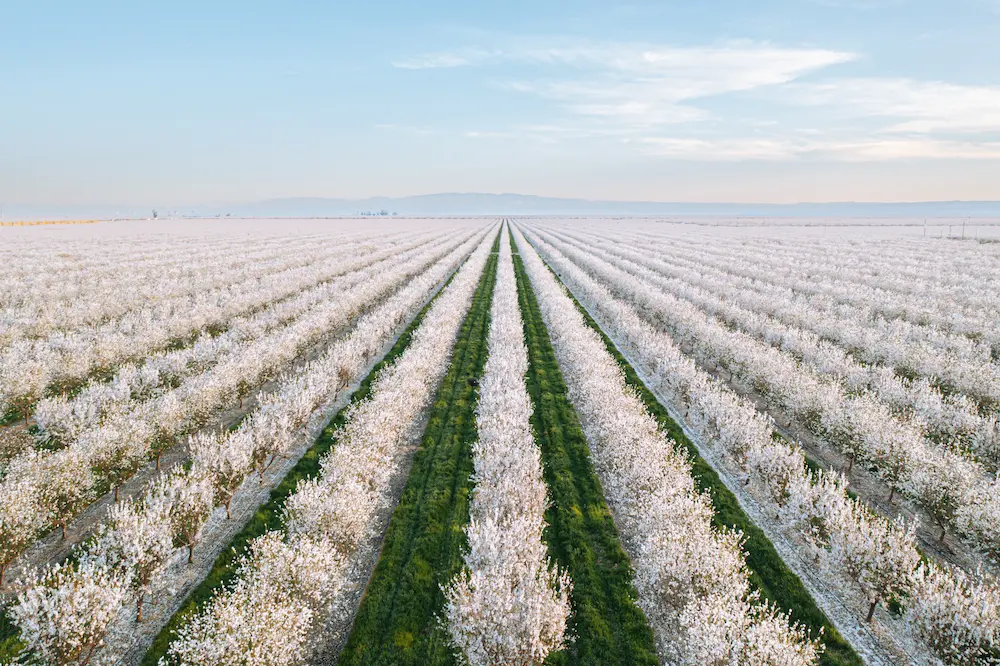
California produces approximately 80% of the world’s almonds, supplying premium ingredients to food manufacturers across more than 100 countries [1]. Behind this dominance stands a network of dedicated almond farmers whose expertise, innovation, and commitment to quality have established California as the undisputed global epicenter of almond production.
California’s position as the world’s almond capital isn’t accidental—it’s the result of unique geographical advantages combined with generations of agricultural refinement.
California’s Central Valley, where most almond production occurs, features a Mediterranean climate characterized by hot, dry summers and mild, wet winters. This climate pattern proves ideal for almond cultivation, providing the winter chill hours almonds require for proper dormancy, followed by warm spring temperatures that support bloom and nut development.
Unlike many agricultural regions, California’s predictable seasonal patterns enable farmers to optimize irrigation, fertilization, and harvest timing with precision rarely achievable elsewhere.
Unlike many agricultural regions, California’s predictable seasonal patterns enable farmers to optimize irrigation, fertilization, and harvest timing with precision rarely achievable elsewhere.
California almond farmers leverage sophisticated soil analysis and precision irrigation systems to maximize both yield and quality. Micro-drip and spray irrigation technologies, pioneered in California almond orchards as early as the 1990s, deliver water directly to root zones while minimizing waste.
Modern growers continuously monitor soil moisture, nutrient levels, and salinity, adjusting inputs to maintain optimal growing conditions. This level of control produces almonds with consistent size, flavor profile, and nutritional content—critical factors for industrial applications where variability creates production challenges.
Many California almond operations represent multi-generational family farms where knowledge passes from parent to child, creating institutional expertise that extends decades.
These farmers understand how subtle climate variations affect bloom timing, how soil composition influences kernel characteristics, and how harvest methods impact final product quality. This accumulated wisdom, combined with willingness to adopt new technologies, creates a uniquely sophisticated farming community.
The almond farmers in California increasingly employ precision agriculture technologies including GPS-guided equipment, drone-based orchard monitoring, weather prediction systems, and data analytics platforms.
These tools enable farmers to identify issues before they impact quality, optimize resource usage, and document practices for traceability systems. The integration of traditional knowledge with cutting-edge technology positions California almond farmers at the forefront of global agriculture.
California’s almond industry delivers unmatched production scale and reliability. The state’s more than 1.3 million acres of almond orchards produce [2] consistent annual harvests, providing food manufacturers with the supply security needed for long-term planning. This scale also supports infrastructure development—from specialized equipment manufacturers to research institutions—that continuously improves quality and efficiency across the industry.
Treehouse California Almonds exemplifies the family farming tradition that characterizes California almond production. Founded by Dr. John Malley in 1969, Treehouse began as a vision to plant almond trees in California’s fertile Southern San Joaquin Valley. Over the decades, the operation evolved from farm to vertically integrated processor, always maintaining its commitment to family values.
Over the past decade and beyond, under the guidance of the Gardiner Family and Treehouse’s dedicated ownership group, the company has continued to demonstrate an unwavering passion for perfect almonds and almond ingredients. This passion extends beyond product quality to encompass careful stewardship of grower relationships and environmental resources.
The family farming model creates unique advantages. Multi-generational operations maintain long-term perspectives, investing in orchard health and sustainability rather than maximizing short-term returns. Treehouse remains small enough to provide personal connections with customers while being large enough to supply the volumes global manufacturers require. This combination of family farm values with the ability to meet the highest quality and food safety standards in the industry distinguishes California’s leading almond suppliers.
Family farmers develop deep connections to their land, understanding orchard microclimates and soil characteristics that influence almond quality. These relationships foster careful stewardship, as families aim to pass productive orchards and thriving businesses to future generations.
Modern California almond farmers like Treehouse’s partners integrate traditional farming with advanced technology and environmental stewardship. Treehouse growers have adopted solar-powered irrigation systems, installed high-efficiency micro-drip technology, and implemented precision monitoring systems that optimize water usage while maintaining quality. This integration demonstrates how California almond farmers balance productivity with resource conservation.
The partnership model Treehouse employs: working directly with select growers who share its values ensures alignment between farming practices and processing requirements. These partnerships enable investment in orchard improvements, adoption of sustainable practices, and maintenance of quality standards from tree to finished product.
The quality delivered by California almond farmers directly influences characteristics critical to industrial food production:
Product characteristic | Farming practices that influence it | Industrial impact | Quality indicator |
Color Consistency | Proper irrigation timing, controlled harvest maturity, careful handling protocols | Meets strict visual specifications for premium bakery and confectionery applications | Uniform kernel color, minimal skin discoloration |
Flavor Profile | Soil composition management, variety selection, irrigation scheduling, nutrient balance | Clean, sweet flavor essential for chocolate, dairy alternatives, and snack products | Absence of bitterness, consistent taste across batches |
Texture & Crunch | Harvest timing, moisture management, storage conditions, handling techniques | Optimal slicing performance, maintains structural integrity in processing | Firm kernels, low breakage rates, consistent density |
Oil Content | Irrigation practices, harvest maturity, varietal characteristics, growing conditions | Affects shelf life, processing yield, and performance in butter and oil production | 50-60% oil content range, consistent across lots |
Kernel Size & Shape | Variety selection, pollination management, tree nutrition, water availability | Determines slicing yield, dicing uniformity, and suitability for specific applications | Uniform sizing (27/30 or 25/27 counts), minimal doubles |
Defect Levels | Pest management, harvest timing, post-harvest handling, quality grading at source | Reduces waste, ensures food safety compliance, maintains brand reputation | <2% serious damage, <1% insect damage, minimal foreign material |
California almond farmers increasingly adopt practices that enhance environmental sustainability while maintaining productivity:
Soil health enhancement: Progressive farmers implement cover cropping, compost application, and reduced tillage practices that build soil organic matter, improve water retention, and support beneficial microbial communities. Treehouse’s participation in The Almond Project demonstrates commitment to soil health research and scalable implementation across partner farms.
Understand more about The Almond Project clicking here.
Responsible pollination practices: Almond bloom requires honey bee pollination, making bee health essential. Leading California farmers create pollinator-friendly environments through habitat plantings, pesticide management, and collaboration with beekeepers. Treehouse growers maintain over 18,000 acres certified through the Bee Friendly Farming program, demonstrating commitment to pollinator welfare.
Environmental impact reduction: Farmers employ integrated pest management to minimize chemical inputs, utilize biomass from orchard removal for soil enhancement through Whole Orchard Recycling, and optimize equipment efficiency to reduce fuel consumption and emissions.
Sustainability certifications: California’s leading almond farmers participate in comprehensive programs including the California Almond Sustainability Program (CASP), recognized at SAI Platform gold-level equivalency. Treehouse has 70% of partner orchards registered in CASP, enabling customers to make verified sustainability claims.
California almond farmers operating at the highest levels maintain rigorous traceability and safety protocols:
Farm-level documentation: Advanced growers maintain detailed records of planting dates, varietal information, input applications, irrigation schedules, and harvest data. This documentation enables complete traceability from specific orchard blocks through processing to final products.
Consistent lot management: Proper handling at harvest preserves lot integrity, enabling processors to track almonds from specific farms or even individual orchards. This consistency supports quality investigations, recall precision, and certification of origin claims.
International compliance: California almond farmers work within regulatory frameworks that meet or exceed international food safety standards. Compliance with USDA organic standards, GlobalG.A.P., and other certifications positions California almonds for global market access.
Quality assurance for global industry: The combination of farmer expertise, documented practices, and integrated processing systems enables California almond suppliers to deliver the consistency and safety required by multinational food manufacturers.
Industrial buyers gain distinct advantages when sourcing from companies like Treehouse that maintain direct farmer partnerships:
Partner with California’s leading almond farmers. Treehouse California Almonds combines over 40 years of family farming heritage with direct partnerships with California’s most progressive growers. Our vertically integrated approach ensures the quality, consistency, and sustainability industrial food manufacturers require.
Contact us to learn how our farmer partnerships can support your almond ingredient needs with superior quality and complete traceability from orchard to your facility.
[1] Almonds Board – Global Market Overview – United States – https://www.almonds.org/almond-industry/regulatory-and-trade/global-markets-overview/united-states
[2] USDA (United States Department of Agriculture National Agricultural Statistics Service) – 2025 California Almond Objective Measurement Report – https://www.nass.usda.gov/Statistics_by_State/California/Publications/Specialty_and_Other_Releases/Almond/Objective-Measurement/202507almondOM_revised.pdf

Be in the loop for vital news about the California almond market.
Enjoy 10% off when you order 6 or more