Empty cart
Oh no! It appears your cart is empty. Add some almonds to your daily regime with the Treehouse products.
All Blog PostsAlmond Market UpdatesNews

When food manufacturers and industrial buyers talk about almonds, the term processed almonds covers a wide spectrum of products: from blanched kernels ready for confectionery lines to precision-cut slices destined for breakfast cereals or fine almond flour formulated for bakery applications. Understanding exactly what processed almonds mean from an industrial perspective is essential for making sourcing decisions that affect product quality, production efficiency, and overall business profitability.
This article breaks down the full industrial picture: what distinguishes raw (in-natura) almonds from almonds ready for industrial use and the stages of processing.
From a commercial standpoint, the difference between raw (in-natura) almonds and processed almonds is not simply about cooking or flavoring. It is about industrial readiness, whether the almond kernel has been transformed into a form that can be integrated directly into a manufacturing process without additional preparation at your facility.
Raw or natural whole almonds arrive from the orchard after hulling and shelling. They retain their natural skin, intact cellular structure, and full moisture content. While they have a longer shelf life due to lower surface-area exposure to air, they require significant in-house processing before they can be used in most food manufacturing lines.
Processed almonds, by contrast, have undergone one or more of the following industrial transformations at a dedicated almond processing facility:
Natural almonds may be processed into different forms: blanched, roasted, sliced, slivered, diced, or ground — for ingredient or snacking applications. Each of these forms involves heat and/or size reduction treatments that directly affect the almond’s shelf life, surface chemistry, and functional behavior in a recipe or manufacturing line.
Modern almond processing follows a well-defined sequence of operations. Understanding this chain helps procurement teams evaluate supplier capabilities and quality controls.
After harvest, almonds arrive at processing facilities from the orchard and are sorted by shape, size, and application using multi-stage electronic sorting systems. Almonds at commercial processing plants pass through at least five stages of electronic sorting prior to final hand sorting, using technologies such as biometric moisture and oil-content scanners, laser contrast systems, and increasingly, X-ray machines to identify defects.
Pasteurization is a mandatory food safety step that applies regardless of the final processed form, whether the almonds will be sold as whole kernels, sliced, or ground into flour.
Blanching is the process of removing the almond’s outer skin, typically through hot water or steam treatment. Blanched almonds have a smooth, white appearance that is essential for applications where visual purity is important .
Roasting is a heat process used to modify the texture, color, and flavor profile of almond kernels. It is one of the most impactful processing steps in terms of shelf life and functional properties.
Industrial roasting is carried out at temperatures between 265°F and 320°F (~130 to 160°C). Roasting at the lower end of this range — between 265°F and 293°F (~130 to 145°C) — helps preserve the almond’s microstructure and maximize product shelf life. Dry-roasted almonds are primarily used in chocolates, confectionery products, breakfast cereals, baked goods, and snacking applications. Oil-roasted almonds are used in ice cream and snacking.
A critical technical consideration for industrial buyers: roasting temperature has a much greater influence on the final acrylamide content of roasted almonds than roasting time. Research funded by the Almond Board of California and published in the Journal of Agricultural and Food Chemistry found that roasting below 295°F (146°C) to achieve a light- or medium-roasted product will minimize acrylamide formation.
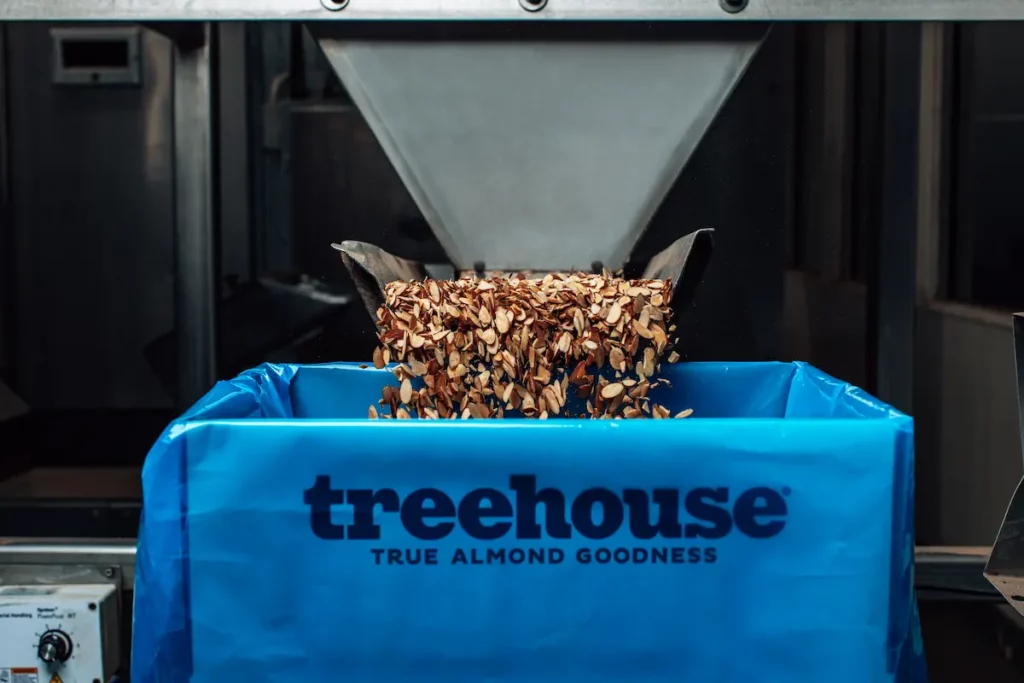
Once blanched (or in natural form), almonds are cut or ground according to specification. This stage directly determines the final processed almond product form and involves precision mechanical operations. At suppliers like Treehouse Almonds, state-of-the-art slicing technology allows for exact control of slice thickness, with the same precision-cut specification deliverable year after year — a key supply consistency requirement for large-scale food manufacturers.
Below is an overview of the main processed almond forms available for industrial purchase, with their primary applications and relevant industrial notes.
| Product form | Primary industrial applications | Industrial notes |
|---|---|---|
| Whole Natural | Trail mixes, snack products, chocolate coatings, roasted nut mixes | Longest shelf life; requires additional in-house processing for most formulated products |
| Blanched Whole | Confectionery, marzipan, almond paste, ingredient applications requiring visual purity | Skin removed; ready for further size reduction or direct use |
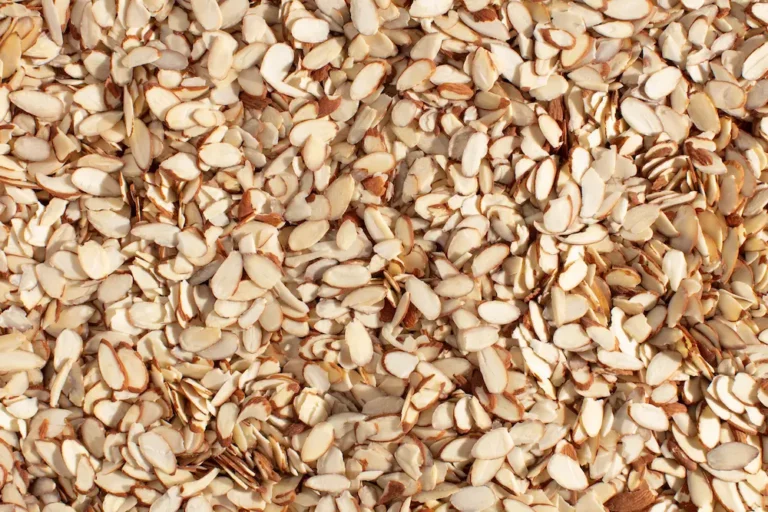
| Sliced (Blanched or Natural) | Bakery toppers, cereals, breakfast applications, salads, chocolates | Available in multiple thicknesses (e.g., 0.61 mm to 1.65 mm); blanched or natural, roasted or raw |
| Slivered | Baked goods, garnishes, salads, confectionery | Julienne-cut blanched almonds; consistent format for topping and blending |
| Diced | Snack bars, chocolate inclusions, baked goods, ice cream inclusions | Standardized cube sizes for uniform texture in formulations |
| Almond Flour / Meal | Gluten-free baking, protein bars, coatings, confectionery fillings | High-protein, gluten-free ingredient; moisture-sensitive; requires proper storage |
| Almond Butter | Spreads, confectionery fillings, protein products, dairy alternatives | Ground emulsified paste; high fat content requires nitrogen-flushed or vacuum packaging |
| Almond Oil | Food processing, cosmetics, industrial applications | Cold-pressed or refined; used as a cooking medium or functional ingredient |
| Almond Protein Powder | Sports nutrition, functional food formulations | High-protein fraction; often a by-product of almond flour or oil extraction |
Industrial buyers often face a make-or-buy decision around almond processing. The strategic question is: should you source whole almonds and process them in-house, or should you source almonds that are already processed to specification?
Sliced, diced, slivered, blanched, and almond flour provide companies with flexibility and consistency in production through ease of use (pre-cut or ground options streamline manufacturing), standardization of texture and size (crucial for baked goods, confectionery, and formulated food products), better ingredient integration (almond flour, butter, and pastes blend seamlessly into recipes), and customizable options (different sizes, textures, and processing levels available).
Whole almonds, on the other hand, offer a longer shelf life and higher consumer visual appeal, but they require additional processing at your facility, which increases complexity and cost depending on your operational setup.
The right answer depends on your production infrastructure, batch consistency requirements, supply chain risk tolerance, and the specific applications within your product line. For most large-scale food manufacturers sourcing almonds for formulated products, pre-processed almond forms eliminate a major operational variable and reduce total cost of ownership when sourced from a qualified supplier.
Treehouse California Almonds has been setting the standard for premium, value-added almond products and ingredients for more than 40 years. As California’s leading grower-partnered almond supplier, Treehouse provides industrial buyers with high-quality whole and processed almond solutions, including sliced, slivered, diced, blanched, roasted, flour, butter, and organic options, tailored to specific business needs and production specifications.
Be in the loop for vital news about the California almond market.
Enjoy 10% off when you order 6 or more