Empty cart
Oh no! It appears your cart is empty. Add some almonds to your daily regime with the Treehouse products.
All Blog PostsAlmond Market UpdatesNews

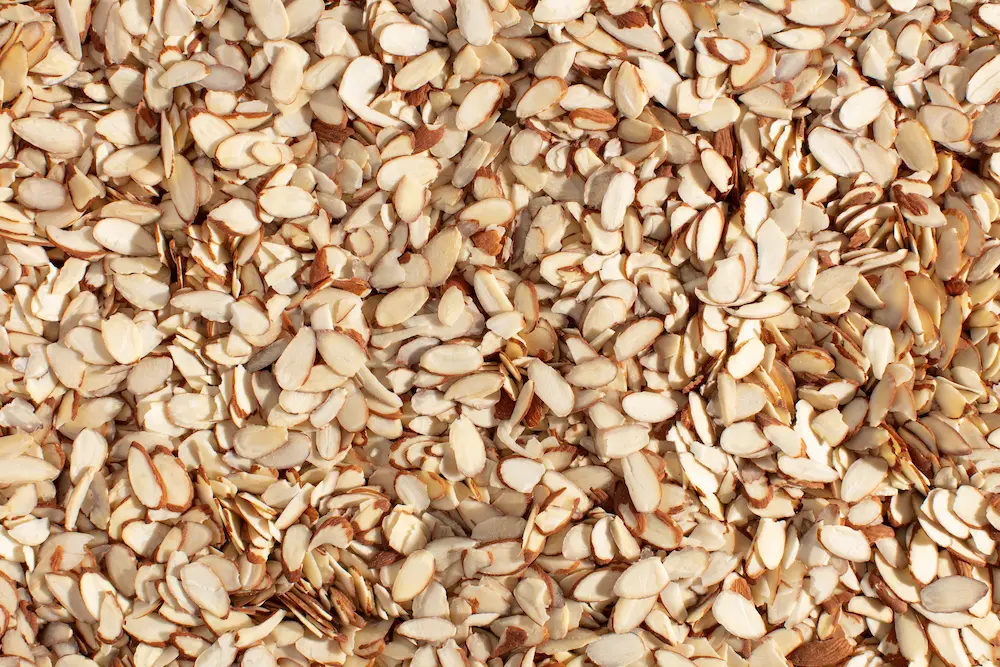
When scaling food production to industrial levels, every ingredient decision impacts efficiency, cost control, and final product quality. For manufacturers sourcing almonds in bulk, understanding the technical advantages of sliced almonds can mean the difference between seamless production runs and costly operational inefficiencies.
In this article we examine sliced almonds from an industrial perspective, providing procurement managers and R&D teams with the technical insights needed to optimize their supply chain decisions.
Sliced almonds are precision-cut almond kernels processed to achieve uniform thickness specifications, typically ranging from 0.61mm (extra thin) to 1.65mm (thick). Unlike other almond formats, sliced almonds are engineered for consistent dimensions, making them ideal for automated production environments.
The choice between different almond formats directly impacts your production process, cost structure, and final product characteristics:
The physical format of your almond ingredient affects material flow, adhesion properties, heat transfer consistency, and cost per application. Sliced almonds demonstrate superior flow characteristics through automated equipment, provide better adhesion to batters and coatings while using less material, and ensure uniform heat exposure during processing.
Precision-cut sliced almonds from quality suppliers maintain thickness tolerances within ±0.1mm, delivering predictable product weight in automated depositing systems, uniform processing times, and consistent sensory experience. They provide efficient coverage ratios—one pound of sliced almonds covers significantly more surface area than whole almonds—enabling superior cost control per portion.
Sliced almonds optimize performance in automated lines with consistent flow through vibratory feeders, minimal jamming in application heads, and uniform distribution in topping systems. Properly processed sliced almonds maintain >70% whole slice integrity, reducing dust generation, filter maintenance costs, and product loss during handling.
Consumer perception of quality begins with appearance. Sliced almonds provide consistent size and shape for uniform product presentation, optimal blanched color when specified, and distinctive premium appearance that differentiates products on shelf.
| Industry sector | Primary products | Recommended thickness | Almond type | Key benefit |
|---|---|---|---|---|
| Industrial bakery | Croissants, bear claws, Danish pastries, artisan breads, cookies | 1.19–1.65mm (regular to thick) | Natural, blanched, or roasted | Superior adhesion to egg wash; premium appearance |
| Chocolate & confectionery | Chocolate bark, clusters, pralines, inclusion bars | 0.61–0.76mm (extra thin to thin) | Blanched or roasted | Efficient enrobing; consistent chocolate-to-almond ratio |
| Pastry & desserts | Cakes, tarts, sweet rolls, frozen desserts | 1.19–1.65mm (regular to thick) | Blanched | Elegant appearance; maintains crispness |
| Ice cream & frozen | Premium ice cream, frozen yogurt, novelty bars | 1.65mm (thick) | Roasted | Maximum textural contrast; freeze-thaw stability |
| Cereal & snacks | RTE cereals, granola, trail mix, nutrition bars | 0.76–1.19mm (thin to regular) | Roasted or natural | Superior flow in mixing; consistent piece count |
| Plant-based | Non-dairy yogurt, alt-proteins, plant-based cheese | 0.76–1.19mm (thin to regular) | Natural or organic blanched | Clean label; recognizable almond identity |
Industrial bakery: Croissants, bear claws, Danish pastries, artisan breads, and premium cookies. Bakeries typically specify 1.19-1.65mm slices for toppings and 0.76mm for delicate pastries.
Chocolate & confectionery: Chocolate bark, almond clusters, pralines, and inclusion bars. Flat profile allows efficient enrobing; confectioners often prefer 0.61-0.76mm for delicate confections.
Pastry & desserts: Cakes, tarts, and frozen desserts. Blanched sliced almonds provide clean, elegant appearance and maintain crispness in moisture-controlled applications.
Ice cream & frozen: Premium ice cream inclusions and novelty desserts. Roasted thick sliced almonds (1.65mm) maintain crunch and provide textural contrast.
Cereal, granola & snacks: Ready-to-eat cereals, granola clusters, and nutrition bars. Thin to regular slices (0.76-1.19mm) provide crunch without overwhelming other ingredients.
Plant-based products: Non-dairy yogurts, plant-based proteins, and alternative products. Natural or organic blanched slices align with clean-label trends while contributing protein and healthy fats.
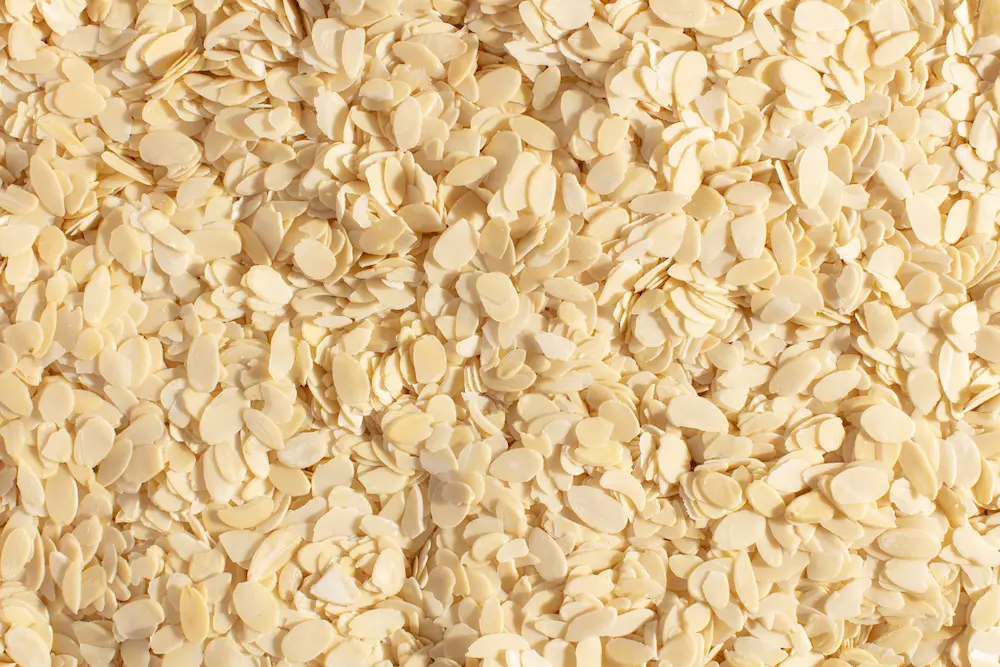
What is the difference between sliced and slivered almonds?
Quality sliced almonds improve production efficiency through enhanced flow characteristics (30-40% better flow rates through inclined conveyors compared to diced almonds), reduced downtime from equipment cleaning and calibration, lower breakage rates during handling, and superior compatibility with automated topping and coating equipment.
Specification sheets should state target thickness, acceptable tolerance range (typically ±0.1mm), and statistical process control data demonstrating batch-to-batch consistency.
California-grown almonds (Nonpareil, Carmel, Monterey varieties) offer distinct processing characteristics. Premium operations typically specify 25/27 or 27/30 count almonds for large, attractive slices.
Advanced rotary cutting systems produce cleaner edges with less cellular damage. Suppliers using state-of-the-art technology provide tighter specifications and lower variation.
Modified atmosphere packaging (MAP) or vacuum packaging extends shelf life. Proper storage at 35-45°F (2-7°C) with 55-65% relative humidity prevents moisture absorption and maintains crispness.
Industrial production requires comprehensive certifications and sustainability commitments. Leading suppliers like Treehouse California Almonds maintain:
Food safety & quality standards:
Sustainability Certifications:
Direct relationships with vertically integrated producers offer significant benefits:
Complete traceability: field-to-facility tracking, complete documentation of growing practices, and direct access to food safety records.
Supply consistency: priority allocation during tight markets, long-term supply agreements, and proactive crop forecast communication.
Custom specifications: development of proprietary thickness specifications, custom roasting profiles, adjusted moisture content, and optimized packaging formats.
Technical support: collaborative product development, process optimization recommendations, troubleshooting assistance, and regulatory support.
Volume pricing: direct pricing without intermediary margins, transparent pricing mechanisms, and volume discounts reflecting true economies of scale.
Agile response: faster order fulfillment, flexible scheduling, emergency supply access, and coordinated delivery planning that minimizes inventory costs.
In industrial food production, ingredient selection optimizes a complex system of cost, quality, efficiency, and consistency. Sliced almonds, when properly specified and sourced from capable producers, deliver measurable advantages across all dimensions.
Manufacturers who achieve greatest success understand technical differences between almond formats, partner with vertically integrated producers offering consistency and customization, implement rigorous quality assurance systems, and optimize processing equipment to leverage sliced almond characteristics.
Ready to discuss your sliced almond requirements? Treehouse California Almonds combines over 40 years of expertise with state-of-the-art slicing technology. Contact us to request samples, discuss custom specifications or have a personalized order tailored for your needs.

Be in the loop for vital news about the California almond market.
Enjoy 10% off when you order 6 or more