
Empty cart
Oh no! It appears your cart is empty. Add some almonds to your daily regime with the Treehouse products.
All Blog PostsNews

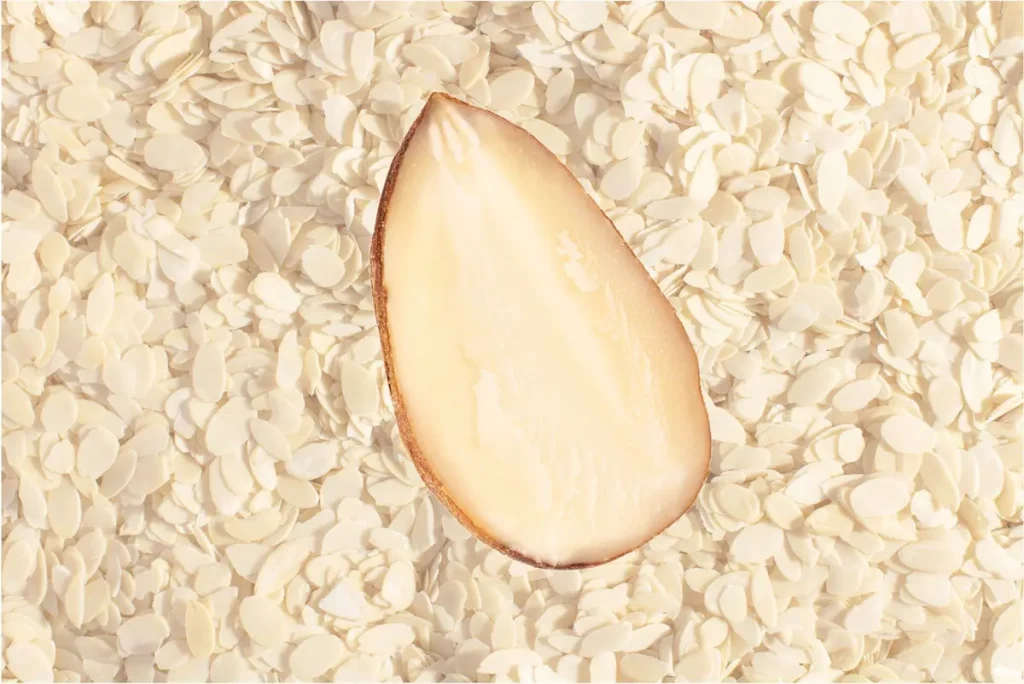
Slice thickness is a formulation variable — not just a product description. A guide for R&D teams and procurement managers specifying sliced almonds for industrial food applications.
Most procurement conversations about sliced almonds start with the wrong question. The question is usually ‘blanched or natural?’ — but slice thickness is what most directly affects finished-product performance. A 0.61 mm blanched slice and a 1.65 mm blanched slice behave differently under heat, absorb moisture at different rates, and suit entirely different applications.
What follows covers how slice thickness works as a formulation variable; what thin almonds and almond pieces mean in a procurement context; how quality grades translate into production yield and visual consistency; and how blanched, natural, roasted, and organic options add a second specification dimension once thickness is set.
The almond industry uses a mix of technical and informal terminology that can create ambiguity in procurement conversations. Before specifying, it helps to know which terms have precise definitions and which do not.
A defined processing format: the whole or blanched kernel is cut transversally — across the width of the kernel — into thin cross-sections. The result is an oval or rounded flat piece whose thickness is the primary specification variable. Sliced almonds are distinct from slivered almonds, which are cut lengthwise into rod-shaped pieces, and from diced almonds, which are cut into uniform cubes. This article focuses on sliced almonds.
An informal commercial descriptor, used inconsistently across the industry. In most contexts it refers to sliced almonds at the thinner end of the available range — typically 0.61 mm to 0.76 mm — but the term has no standardized definition in USDA specifications or food labeling regulations. When a supplier or catalog uses the term thin almonds, always request the thickness specification in millimeters before ordering.
Another informal descriptor, used to refer to broken slices, damaged kernels, or lower-grade sliced almond lots that contain a higher proportion of fractured pieces relative to whole slices. In a quality-grade context, almond pieces often correspond to sliced almond lots where the whole slice yield falls below the standard grade threshold (70% whole slices). For industrial applications where visual consistency matters, almond pieces are generally not a suitable specification; for applications where broken pieces are acceptable or irrelevant — almond flour blends, certain bakery mixes — they may offer a cost advantage.
In industrial specification, replace these informal terms with precise parameters: thickness in millimeters, whole slice yield percentage, discoloration percentage, and serious damage percentage. Those four numbers describe the product with enough precision to specify, order, and verify a shipment. The product name does not.
Source: Treehouse Almonds — Sliced vs. Slivered Almonds
Slice thickness affects texture, crunch intensity, visual appeal, moisture absorption, and structural performance under heat. The four main thickness ranges from Treehouse each map to a distinct set of applications.
| Thickness | Input AOL | Texture Profile | Best-Fit Applications |
|---|---|---|---|
| Extra thin: 0.61 mm | 25/27 AOL | Delicate, nearly translucent; light crunch | High-speed bakery lines, croissants, fine pastry surfaces, thin cake layers |
| Thin: 0.76 mm | 25/27 AOL | Slightly more defined crunch; maintains translucency | Pastry toppings, tarts, fine baked goods where presence and delicacy are both required |
| Regular: 1.19 mm | 27/30 AOL | Satisfying bite; holds structure in wet environments | Ready-to-eat cereals, overnight oats, yogurt toppings, chocolate coatings |
| Thick cut: 1.65 mm | 27/30 AOL | Pronounced crunch; clear visual presence | Salads, grain bowls, premium bakery inclusions, applications where the almond must be seen and felt |
Source: Treehouse Almonds — Sliced Almonds Wholesale
At 0.61 mm, sliced almonds are thin enough to be nearly translucent. On a croissant or pastry surface, they lay flat against the dough, adhere well during proofing and baking, and develop a light golden color that reads as a topping rather than a visible inclusion. On high-speed automated bakery lines, thin slices distribute more evenly from dosing equipment, reducing waste and improving coverage per unit.
Thin sliced almonds also work in fine cake layers, tarts, and applications where a decorative almond element must not dominate the product visually or texturally. Their lower structural mass makes them more susceptible to breaking during handling — which is why whole slice yield is particularly important to specify at this thickness.
At 0.76 mm, sliced almonds occupy the middle ground between extra thin and regular — enough presence to be clearly felt in a finished product while still maintaining the delicate, flat profile that makes almond slices effective as a surface topping. This thickness suits applications where extra thin reads as too light visually but regular would be structurally distracting: tarts with an arranged almond surface, pastry crowns, and fine baked goods where both the appearance and the texture of the almond need to register without overpowering the format.
The 25/27 AOL input is shared with extra thin, which means the base kernel size and shape are the same — only the cut depth differs. For manufacturers alternating between 0.61 mm and 0.76 mm across product lines, this input consistency simplifies sourcing without requiring a change in base almond specification.
At 1.19 mm, sliced almonds hold their structure in environments where moisture is present. Ready-to-eat cereals are a primary application: the slice is thin enough to toast evenly during cereal processing but thick enough to survive a bowl of milk without disintegrating immediately. Overnight oats and yogurt toppings work for the same structural reason — the almond contributes crunch on first contact and softens gradually.
Regular sliced almonds also work in chocolate coating applications, where the slice must adhere to the chocolate surface and stay visibly distributed across the coated product. The 27/30 AOL input gives regular slices a slightly larger base kernel than extra thin, which contributes to the more pronounced texture.
Thick cut sliced almonds are the right specification when the almond needs to be both seen and felt in the finished product. In salads and grain bowls, a 1.65 mm slice holds up after dressing contact and delivers a crunch that a thinner slice would not survive. In premium bakery applications — an almond tart where slices are arranged before baking, or a decorated cake layer — thick cut slices remain visually distinct through the process.
The structural mass of thick cut slices also makes them more tolerant of mechanical handling in production lines with longer ingredient pathways or higher drop heights between dosing and product assembly.
Thickness sets what the almond can do in an application. Grade determines how consistently it does it across a production run.
More than 70% whole slices, less than 1% discoloration, and less than 2% serious damage. This is the commercial baseline for most food manufacturing applications. In a standard-grade lot, up to 30% of the volume may be broken or partial slices — which is acceptable in applications where broken pieces blend into the product or where visual inspection of individual slices is not a quality checkpoint.
More than 80% whole slices, less than 0.5% discoloration, and less than 1% serious damage. TQ grade provides tighter tolerances across all parameters, which translates to more consistent coverage, more uniform appearance in the finished product, and a lower rate of visual defects across production batches.
For applications where each almond slice is individually visible in the finished product — a pastry surface, a chocolate-coated confection, a premium cereal where slice appearance is part of the product’s visual identity — TQ grade is worth the cost premium. For applications where slices are incorporated into a matrix (a batter, a bar, a coating mix) where individual slices are not visible in the finished product, standard grade provides adequate performance at a lower cost.
Source: Treehouse Almonds — Sliced vs. Slivered Almonds (grade parameters)
Once thickness and grade are established, the choice of base processing adds a second specification dimension that affects color, flavor, shelf life, and labeling.
Source: Treehouse Almonds — Sliced Almonds Wholesale
| Application | Recommended Specification | Key Reason |
|---|---|---|
| Croissants and fine pastry | Blanched extra thin (0.61 mm), TQ grade | Lays flat against dough; even color; high whole slice yield for visual consistency |
| Cakes, tarts, and decorated pastry surfaces | Blanched thin (0.76 mm), TQ grade | Slightly more presence than extra thin; holds decoration through baking |
| Ready-to-eat cereals | Roasted regular (1.19 mm), standard or TQ | Holds structure in milk; roasting adds flavor and crunch appropriate to cereal segment |
| Overnight oats and yogurt toppings | Blanched or roasted regular (1.19 mm) | Crunch on first contact; gradual softening over soak time |
| Chocolate coatings and confectionery | Blanched regular (1.19 mm), TQ grade | Even adherence to chocolate surface; blanched color reads clean against dark chocolate |
| Salads and grain bowls (foodservice) | Natural or blanched thick cut (1.65 mm) | Structural integrity after dressing contact; visible almond presence in the bowl |
| Premium bakery inclusions | Blanched thick cut (1.65 mm), TQ grade | Distinct visual shape through baking; high whole slice yield for premium appearance |
| Granola and muesli | Natural regular or roasted regular (1.19 mm) | Natural color fits whole-food visual; roasted adds flavor complexity |
| Organic-certified product lines | Organic blanched or natural (any thickness) | CCOF certification with PPO-free pasteurization; required for NOP organic label claims |
Source: Treehouse Almonds — Sliced Almonds Wholesale
Treehouse works with large food producers to fine-tune the thickness of bulk sliced almonds for each product and application. Our sliced almonds wholesale specifications cover the full range from 0.61 mm to 1.65 mm in blanched, natural, roasted, and organic versions, at standard and top quality grade levels, in 25 lb boxes, Vacuum-packet 25 lb, Super Sack 1,700 – 2,200 lbs, and Fiber Bin 1,700 – 2,200 lbs. Our slicing equipment holds the same precise thickness specification year after year. That consistency matters for manufacturers whose formulations are validated against a specific slice thickness and yield: a batch thinner than specified changes the texture; a batch with a lower whole slice yield changes the visual consistency across units. Multi-stage sorting eliminates both variables.
For manufacturers whose required specification sits outside the standard catalog — a custom thickness, a specific yield above TQ, or a proprietary combination of thickness and roast — our development teams work directly with R&D counterparts to build and validate the specification before scale-up. Learn more about how our experts can collaborate with you on our Collaborating with You page, and tell us about your product needs. Storage applies across all sliced almond formats: 35–45°F (2–7°C), 55–65% relative humidity, away from direct sunlight and strong odors. Shelf life is 18 months for blanched and natural, 12 months for roasted vacuum-packed. Certifications include BRC Global Standards, Kosher, Halal, CCOF (organic), Bee Friendly Farming, Sedex, UL, EcoVadis, and CASP. Full details at the food safety and quality systems page.
Questions or larger-volume inquiries (> 1,500 lbs): Contact us directly →
Order samples or small quantities (< 1,500 lbs): Visit the Treehouse Online Shop →
Treehouse Almonds — Sliced Almonds Wholesale
Treehouse Almonds — What is the Difference Between Sliced and Slivered Almonds?
Treehouse Almonds — Sliced Almonds: The Ingredient That Scales the Industry
Treehouse Almonds — Food Safety & Quality Systems
Be in the loop for vital news about the California almond market.
Enjoy 10% off when you order 6 or more