Empty cart
Oh no! It appears your cart is empty. Add some almonds to your daily regime with the Treehouse products.
All Blog PostsNews

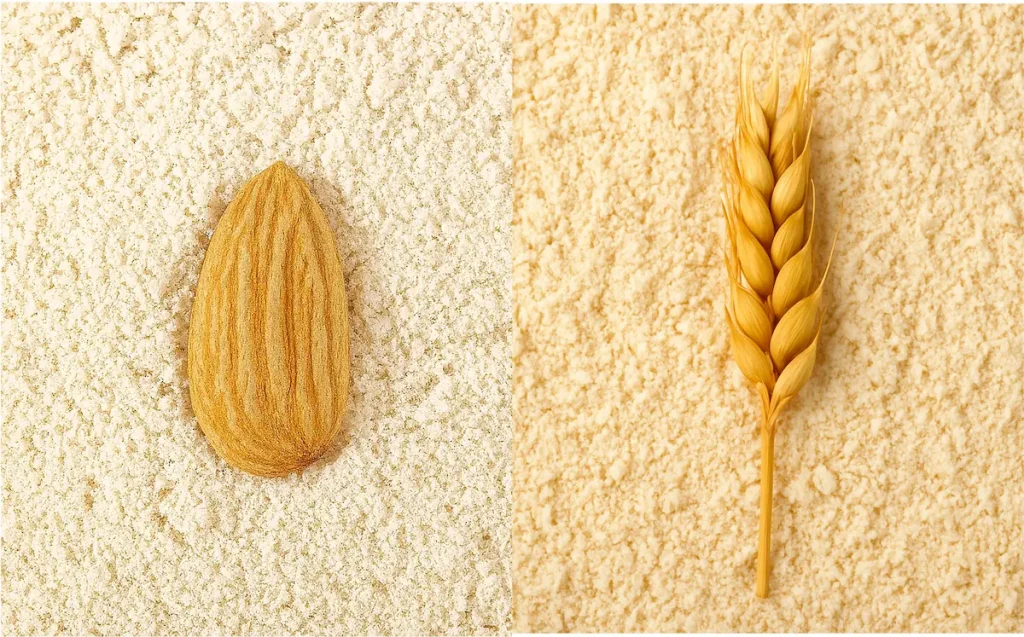
A technical guide for R&D teams and product developers evaluating almond flour as a substitute or complement to all-purpose flour in industrial formulations.
All-purpose flour has long been the default base for food formulations — but it is a structural ingredient with little nutritional contribution beyond carbohydrates. Almond flour offers something fundamentally different: a nutrient-dense, functional ingredient that adds protein, fiber, healthy fats, and flavor, while opening the door to gluten-free, keto, and high-protein product lines.
In this article, we cover: the core compositional differences between almond flour and all-purpose flour — including gluten, protein, fat, and moisture behavior; why these differences make almond flour a high-value addition to formulations rather than just a substitute; which applications benefit most from almond flour or an almond flour blend; and practical guidance on incorporating almond flour at industrial scale.
The starting point for any substitution decision is composition. Almond flour and all-purpose flour differ substantially in protein type, fat content, carbohydrate load, and moisture behavior — and each of these variables drives a different outcome in your formulation.
| Component (per 100g) | Almond Flour | All-Purpose Flour |
|---|---|---|
| Protein | ~23g | ~15.1g |
| Gluten-forming proteins | None | Glutinin and gliadin form gluten |
| Total fat | ~49g (primarily monounsaturated) | ~2.73g |
| Total carbohydrates | ~23g | ~71.2g |
| Dietary fiber | ~9g | ~10.6g |
| Moisture absorption behavior | High fat slows absorption; sensitive to particle size | High starch absorbs water readily; forms gluten network when hydrated |
Source: Almond Board of California — All About Almond Flour
Source: Wheat Foods Council — Flour 101
Source: USDA FoodData Central — Wheat Flour, White, All-Purpose, Enriched, Bleached
All-purpose flour gets its structural versatility from glutinin and gliadin — the two proteins that form gluten when hydrated and mixed. Gluten development is what gives bread its chew, allows pizza dough to stretch, and lets laminated pastry hold its layered structure. According to the Wheat Foods Council, all-purpose flour is milled from hard and soft wheat blends, with protein content ranging from 8–11%, making it versatile enough for a broad range of baking applications.
Source: Wheat Foods Council — Flour 101
Almonds don’t have the same proteins found in wheat flour and other grains. This means almond flour cannot form a gluten network — it has no elasticity, no stretch, and no inherent ability to trap gas from leavening agents. As the Almond Board of California notes, product developers need to work with blends of gluten-free flours, starches, and gums to recreate the taste and texture of wheat-based formulas when using almond flour.
Source: Almond Board of California — All About Almond Flour
Instead of gluten, almond flour provides structure through its high fat content and fine particle binding. This produces a denser, moister crumb with a tender bite — a texture that many premium bakery products specifically aim for. The key distinction is this: all-purpose flour is a structural ingredient with a narrow job (forming gluten), while almond flour is a multifunctional ingredient that contributes protein, fiber, fat, flavor, and moisture — structure is simply one of several things it does, and for laminated doughs or yeasted breads, it does that one job alongside a gluten-forming flour rather than in place of it.
Beyond gluten-free positioning, almond flour is increasingly used as a value-add ingredient in formulations that already use all-purpose flour. The reasons go beyond label claims:
Source: Almond Board of California — All About Almond Flour
For manufacturers, this reframes the question. It is not only “can almond flour replace all-purpose flour?” but also “what does adding almond flour do for this formulation?” In many cases — protein bars, premium cookies, muffin and cake mixes, coatings and breadings — the answer is a meaningfully improved nutritional and sensory profile, often at a partial substitution level that preserves the structural role of all-purpose flour.
Almond flour’s high fat content (roughly 50%) fundamentally changes how it behaves during mixing, baking, and storage compared to all-purpose flour, which is roughly 76% carbohydrate and only 1–2% fat.
Source: Treehouse Almonds — Almond Flour Wholesale
Almond flour carries a higher unit cost than all-purpose flour — and for industrial buyers, that difference is real. But the relevant metric is rarely ingredient cost in isolation. The more useful frame is what that cost enables in the finished product.
Formulations featuring almond flour can support a range of value-adding label claims — gluten-free, high-protein, high-fiber, keto-friendly, or clean-label — that typically command a higher retail price point and access premium or specialty market segments that conventional all-purpose flour formulations cannot reach. In that context, the cost differential between almond flour and all-purpose flour is frequently recovered in product positioning, margin structure, or both.
For manufacturers using almond flour as a partial addition rather than a full substitute — replacing 20–30% of the flour blend — the absolute cost impact per finished unit is also significantly reduced, while the nutritional and functional benefits are still meaningfully present. This makes partial substitution a commercially pragmatic entry point for manufacturers evaluating almond flour for the first time.
The functional differences above translate directly into application fit. The table below maps common food manufacturing categories to the flour — or blend — best suited for each.
| Application | Recommended Flour | Why |
|---|---|---|
| Yeasted breads, pizza dough | All-Purpose Flour (+ almond flour for flavor/moisture) | Gluten development drives rise and chew; a small almond flour addition (5–10%) adds flavor and crumb moisture without disrupting structure |
| Laminated pastry (croissants, puff pastry) | All-Purpose Flour | Dough extensibility depends on gluten network; almond flour is better used as a filling, dusting, or topping in these formats |
| Gluten-free bakery mixes | Almond Flour (1/3 of blend) + GF starches/gums | Almond flour is the primary nutritional and flavor contributor; starches and gums replace the structural role of gluten |
| Keto/low-carb breads, pizza, tortillas | Almond Flour (fine, 20 mesh) | Low net carbs, high protein, and neutral color make almond flour the primary base ingredient |
| Cookies, brownies, dense cakes | Almond Flour or Almond Flour Blend | Almond flour’s fat and protein content produce the dense, moist, tender crumb these products are designed to have |
| High-protein snack bars and bites | Almond Flour (12 mesh) | Protein and fiber contribution is the primary formulation driver; coarser texture adds desirable bite |
| Standard layer cakes, muffins, biscuits | All-Purpose Flour + Almond Flour (20–30%) | Partial substitution adds moisture, flavor, and nutritional density while preserving lift from gluten |
| Coatings, breadings, and crumb toppings | Almond Flour (12 mesh) or blend | Adds protein, color, and a premium flavor profile compared to standard breadcrumb or flour coatings |
The Almond Board of California recommends substituting roughly one-third of a gluten-free flour blend with almond flour for moist and light results — using starches (tapioca, potato, rice) and gums (xanthan, guar) to recreate the binding and aeration that gluten would otherwise provide.
Source: Almond Board of California — All About Almond Flour
Treehouse Almonds offers natural, blanched, and organic almond flour options, available in multiple particle sizes — from extra fine (20 mesh) to coarse (12 mesh) — to support bakery, snack, confectionery, and ingredient manufacturing applications. All formats maintain moisture below 6%, ensuring predictable absorption behavior across production batches. Full almond flour wholesale specifications are available on request.
For manufacturers developing custom gluten-free or hybrid flour blends, Treehouse also offers the Baking & Cookie Almond Flour — a highly versatile blend formulated from combinations of natural, blanched, conventional, and organic almond flour, with ratios customized to match the flavor, texture, color, and performance requirements of each specific application. From pizza crusts and pasta to cookies, crackers, and cereals, this product eliminates the need to source and blend multiple flour types in-house.
Treehouse processes almond flour in a sterile-environment, positive-air facility with steam pasteurization and full farm-to-facility traceability. Certifications include BRC Global Standards, Kosher, Halal, CCOF (organic), Bee Friendly Farming, EcoVadis, and CASP. Industrial packaging options include 25 lb boxes, Super Sacks (1,700–2,200 lbs), and Fiber Bins (1,700–2,200 lbs). For custom granulometry or blend development, Treehouse’s team works directly with your R&D process to validate specifications before production scale-up. Learn more at the Treehouse Food Safety & Quality Systems page.
Questions or larger-volume inquiries: Contact us directly →
Order samples or small quantities: Visit the Treehouse Online Shop →
Source: Almond Board of California — All About Almond Flour
Source: Treehouse Almonds — Almond Flour Wholesale
Source: Treehouse Almonds — Food Safety & Quality Systems
Source: Wheat Foods Council — Flour 101
Source: USDA FoodData Central — Wheat Flour, White, All-Purpose, Enriched, Bleached


Be in the loop for vital news about the California almond market.
Enjoy 10% off when you order 6 or more