
Empty cart
Oh no! It appears your cart is empty. Add some almonds to your daily regime with the Treehouse products.
All Blog PostsNews

Updated in: August 15, 2026
. • All Blog Posts • News
A technical guide for industrial buyers on almond format selection — from visual appeal and texture to yield, shelf life, and production-line performance.
The almond format you specify — whole, halves, sliced, or diced — is one of the most consequential sourcing decisions in almond-containing product development. It directly determines visual appearance, textural experience, processing behavior, ingredient yield, and shelf life.
In this article, we cover: the key functional and visual differences between the four main almond formats; how each format performs across major industrial segments such as confectionery, bakery, snacks, cereals, and salads; the critical specification variables to evaluate when sourcing — including yield rates, particle size tolerances, damage limits, and shelf life; and how Treehouse Almonds ensures format consistency and quality at industrial scale.
Before mapping each format to a segment, understanding their core structural and functional differences helps narrow the decision quickly.
| Format | Visual Profile | Texture | Primary Industrial Role |
|---|---|---|---|
| Whole | Full kernel, skin-on or blanched | Strong crunch; full almond identity | Trail mixes, snack bars, confections, coatings |
| Halves | Kernel split lengthwise; flat face exposed | Bold crunch; decorative adherence | Pastry decoration, cookies, cereals, global recipes |
| Sliced | Thin cross-sections (0.61–1.65 mm) | Light, delicate crunch | Bakery toppings, croissants, cereals, salads, chocolate |
| Diced | Uniform cubes (3.18–11.91 mm range) | Even, controlled crunch inside product | Soft bars, ice cream, chocolate inclusions, bakery |
|
|
|
|
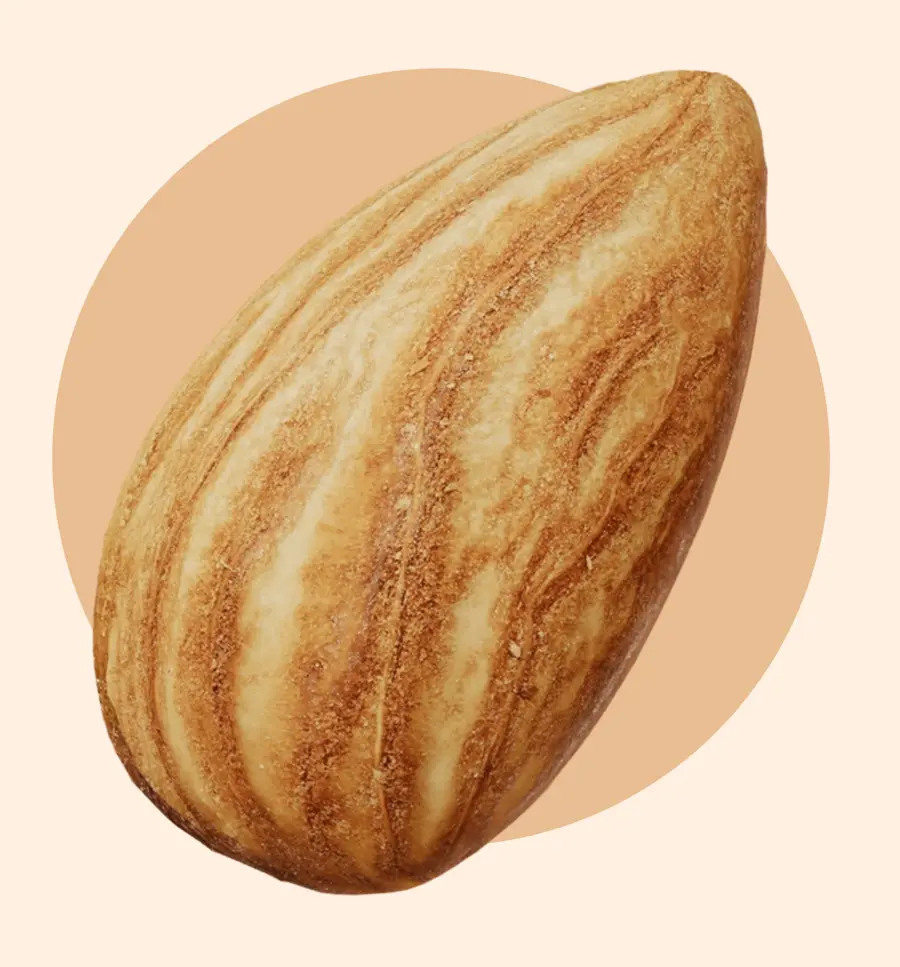
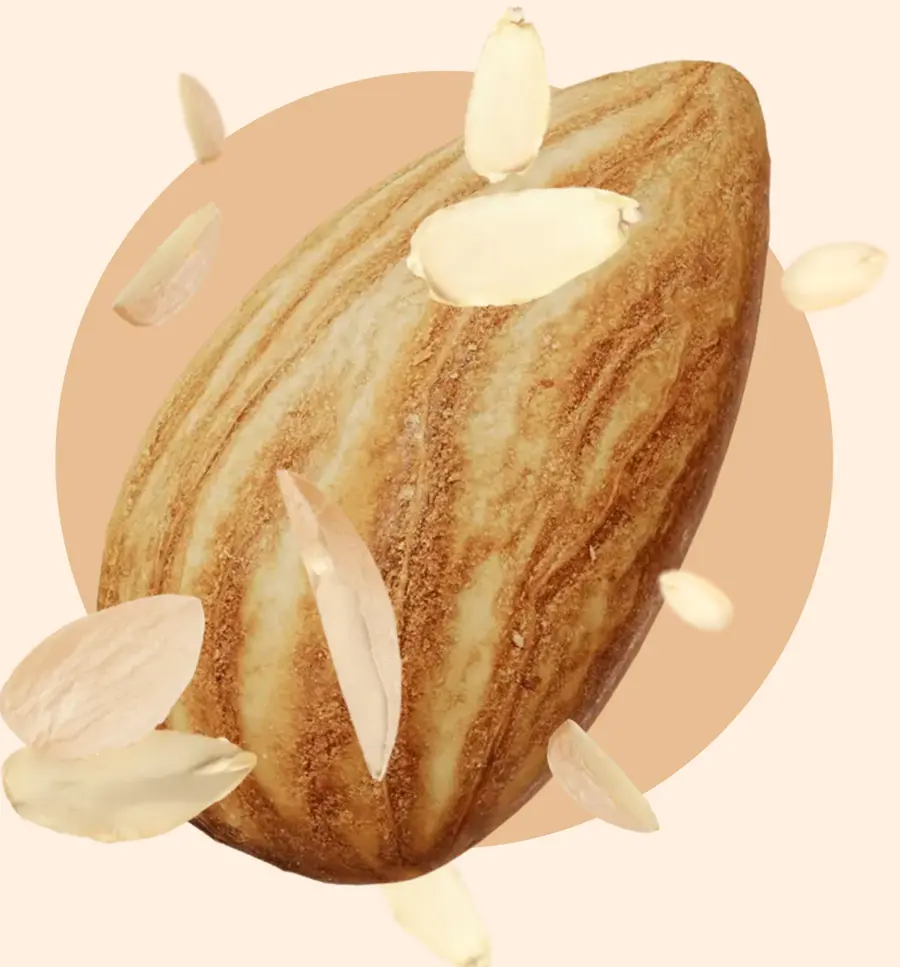
| Whole Almonds | Almond Halves | Sliced Almonds | Diced Almonds |
The four main industrial almond formats — each with distinct visual profile, cut precision, and application fit.
Whole almonds carry the longest shelf life of any almond format — up to 24 months for natural whole almonds stored at 35–45°F (2–7°C) at 55–65% relative humidity. Their intact kernel structure minimizes surface area exposed to air, slowing lipid oxidation. Treehouse sizes whole almonds from 20/22 to 36/40 (kernels per ounce), with multiple grades including Nonpareil Supreme and Select Sheller Run, all maintaining serious damage below 2%. You can review full sizing and grade parameters on the whole almonds wholesale specifications page.
Industrially, whole almonds are the format of choice when strong visual almond identification is a product feature: snack mixes, trail mixes, chocolate bark, energy bars, and confections where the kernel must be seen and recognized.
Almond halves occupy a distinctive position between whole and sliced formats. By splitting the kernel lengthwise, the exposed flat face becomes a key functional asset: it adheres naturally to confections, pastry glazes, and cookie surfaces, and lends itself to decorative arrangements that whole almonds cannot replicate. Treehouse’s almond halves wholesale specifications require a minimum of 85% intact halves (80% for natural dry-roasted), broken pieces not exceeding 15–20%, and serious damage below 2% — yield parameters that directly protect product visual consistency at scale.
This format is standard for Chinese Almond Cookies, Middle Eastern Mansaf, and any application where a precise, recognizable almond face must appear uniformly on every unit. Shelf life is 18 months for blanched halves and 12 months for natural and roasted formats.
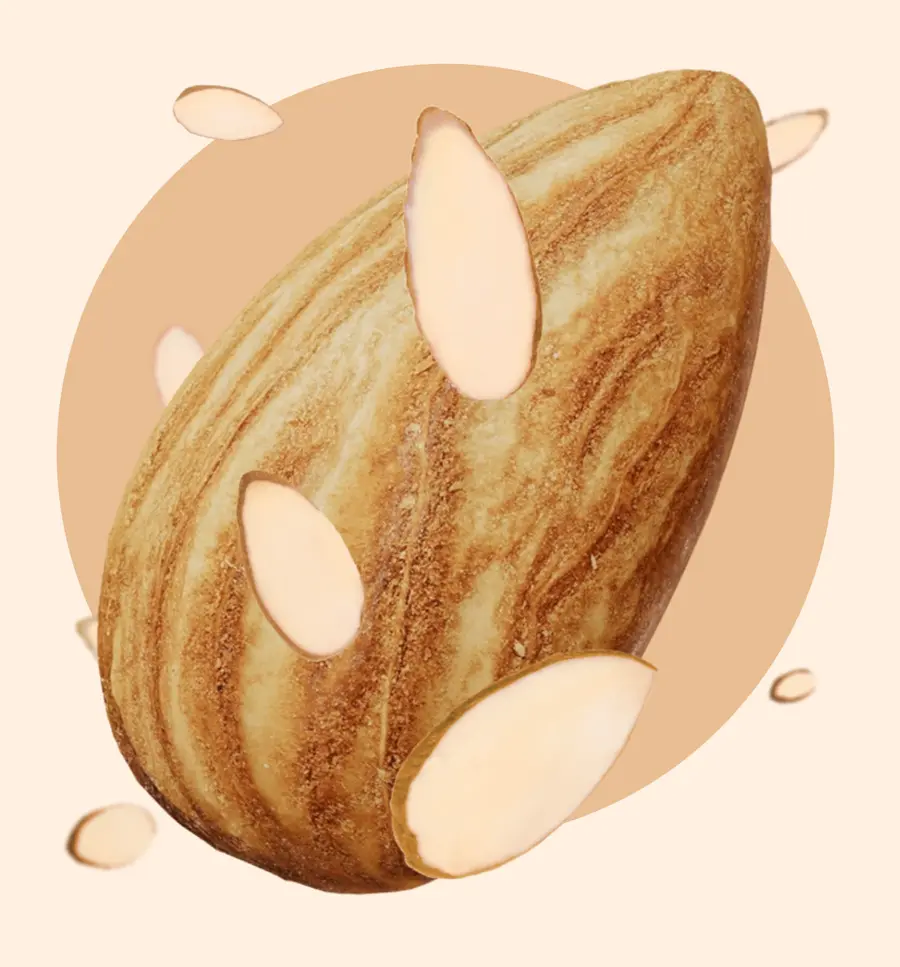
Sliced almonds are cut transversally into thin sections. Treehouse offers thickness options from 0.61 mm (extra-thin) to 1.65 mm (thick-cut), in blanched and natural versions, with quality parameters requiring a minimum whole slice yield above 70% (above 80% for top-quality grades) and serious damage below 2%. The complete thickness range and input sizing are available on the sliced almonds wholesale specifications page.
Extra-thin slices (0.61 mm) deliver a delicate, nearly translucent appearance ideal for croissants and fine pastry surfaces. Regular slices (1.19 mm) provide a satisfying bite in cereals and overnight oat formulations. Thick slices (1.65 mm) hold structure through baking and deliver visible presence in premium salads and grain bowls. Shelf life is 18 months for blanched and natural; 12 months for roasted vacuum-packed.
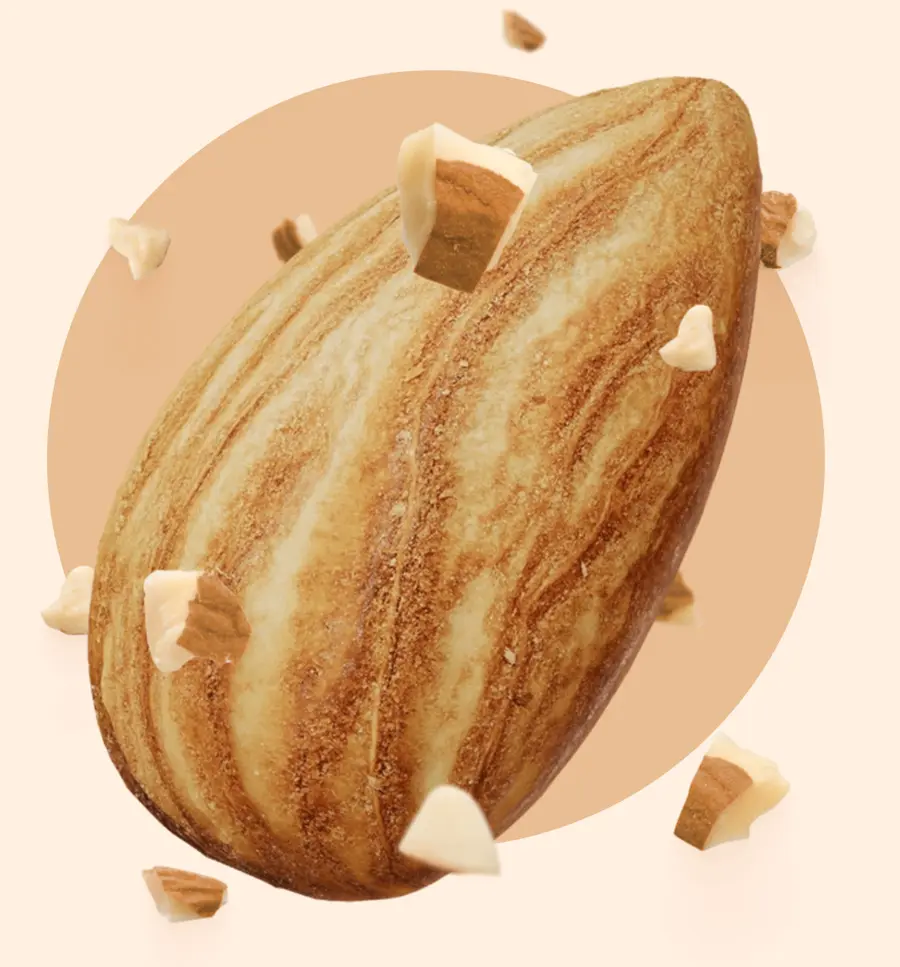
Diced almonds are designed for uniform inclusions where the almond blends into the formulation while delivering a clean crunch. Treehouse offers three standard particle size ranges: 12/8 (4.76–3.18 mm), 22/8 (8.73–3.18 mm), and 30/16 (11.91–6.35 mm), in blanched, natural, and roasted versions. All formats maintain size-validated consistency (minimum 90% through the top screen, maximum 10% through the bottom screen) and moisture below 6%. Full size and screen parameters are published on the diced almonds wholesale specifications page.
Roasted diced almonds are the number one tree nut used in ice cream — used as inclusions in the product and as adherent pieces in coated dairy treats. Smaller diced formats (12/8) are dominant in soft nutrition bars and bakery mixes; larger formats (22/8 and 30/16) deliver a bolder textural experience in premium snack applications. Precise, consistent sizing means food producers can use 100% of what they receive, with zero yield waste.
| Segment | Recommended Format | Key Reason |
|---|---|---|
| Fine Confectionery & Pastry Decoration | Halves (blanched) | Flat face adheres cleanly to glazed surfaces; uniform appearance across units |
| Chocolate Confections & Coating | Whole or Diced 22/8 | Whole: strong visual identity. Diced: even distribution as inclusions in moulded pieces |
| Bakery Toppings (croissants, cakes, muffins) | Sliced extra-thin or regular (blanched) | Thin profile lays flat; neutral color does not darken the finished-product surface |
| Cereals & Breakfast Applications | Sliced regular (1.19 mm) or Whole | Holds bite in milk; consistent almond presence across bowl portions |
| Energy & Snack Bars (soft/chewy) | Diced 12/8 or 22/8 | Controlled particle size ensures even texture distribution in compressed bar format |
| Ice Cream & Dairy Treats | Diced 22/8 (dry roasted) | Top tree nut for ice cream; clings to coatings; delivers crunch contrast to cold product |
| Salads & Foodservice | Sliced thick or Whole | Visible almond presence; holds texture after dressing contact |
| Trail Mixes & Snack Products | Whole (natural or roasted) | Maximum consumer visual appeal; longest shelf life of all formats (24 months natural) |
| Global Traditional Recipes | Halves (natural or blanched) | Standard format for Mansaf, Chinese Almond Cookies, and other culturally recognized applications |
For industrial buyers, format specification is only valuable if the supplier can deliver it reliably across every batch and every season. Treehouse California Almonds has supplied premium almond formats to leading global food companies for more than 40 years. State-of-the-art slicing technology controls thickness year after year; multi-stage laser and electronic sorting validates size, shape, and defect levels for every format. Processing takes place in a 400,000+ sq ft sterile-environment, positive-air facility, with steam pasteurization applied across all formats. Learn more about the quality infrastructure on the Treehouse Food Safety & Quality Systems page.
All formats — whole, halves, sliced, and diced — are available in natural, blanched, dry-roasted, and organic versions. Industrial packaging options include 25 lb and 50 lb boxes, vacuum-packed formats, Super Sacks (1,700–2,200 lbs), and Fiber Bins (1,700–2,200 lbs). Certifications across all formats include BRC Global Standards, Kosher, Halal, CCOF (organic), Bee Friendly Farming, Sedex, UL, EcoVadis, and CASP.
Almond halves are produced by splitting the whole kernel lengthwise into two symmetrical pieces, preserving a flat, recognizable almond face. Sliced almonds are cut transversally into thin cross-sections ranging from 0.61 mm to 1.65 mm in thickness. Halves deliver a bold crunch and are used where visual almond identity on a product surface is important, such as cookies and pastry decoration. Sliced almonds are chosen for their thin, delicate profile and even distribution in bakery toppings, cereals, and salads.
Natural whole almonds have the longest shelf life at up to 24 months when stored at 35–45°F (2–7°C) with 55–65% relative humidity. Blanched whole almonds and most cut formats (sliced, diced) rate at 18 months. Natural halves and roasted vacuum-packed formats are typically rated at 12 months. The longer shelf life of intact formats is a direct result of lower surface area exposure to air, which slows lipid oxidation — the primary quality degradation mechanism in almonds.
Treehouse Almonds offers three standard industrial diced almond sizes: 12/8 (particle range 4.76–3.18 mm), 22/8 (8.73–3.18 mm), and 30/16 (11.91–6.35 mm). All are available in blanched, natural, and dry-roasted versions. Size consistency is verified by screen validation: minimum 90% of particles must pass through the top screen, with maximum 10% passing through the bottom screen. Moisture is maintained below 6% for raw formats and below 3% for roasted.
Blanched almond halves are the preferred format for most confectionery and fine pastry decoration applications. The flat face produced by the lengthwise cut adheres cleanly to glazed surfaces, fondant, and chocolate coatings without the rounding limitations of a whole kernel. For applications requiring visual purity and color neutrality — such as premium cakes or chocolate-enrobed confections — blanched halves eliminate skin-related color variation. For chocolate inclusions where the almond is inside the product rather than visible on the surface, diced almonds at 22/8 particle size are typically more efficient.
Sliced almond thickness in industrial specifications is expressed in millimeters: extra-thin (0.61 mm), thin (0.76 mm), regular (1.19 mm), and thick (1.65 mm). The right thickness depends on the textural experience and visual role you need the almond to play. Thinner slices integrate into batter-based products and lay flat on glazed surfaces. Thicker slices hold structure through baking and deliver a more pronounced bite. Treehouse Almonds’ precision slicing equipment can hold exact thickness tolerances year-over-year, and top-quality grades also include tighter yield parameters (minimum 80% whole slice vs. 70% for standard grade).
Click here to contact us directly and request your specification sheet.
Be in the loop for vital news about the California almond market.
Enjoy 10% off when you order 6 or more