Empty cart
Oh no! It appears your cart is empty. Add some almonds to your daily regime with the Treehouse products.
All Blog PostsNews

A technical guide for industrial buyers and procurement teams sourcing whole almonds at scale — from AOL sizing and USDA grades to shelf life, nutritional profile, and application fit.
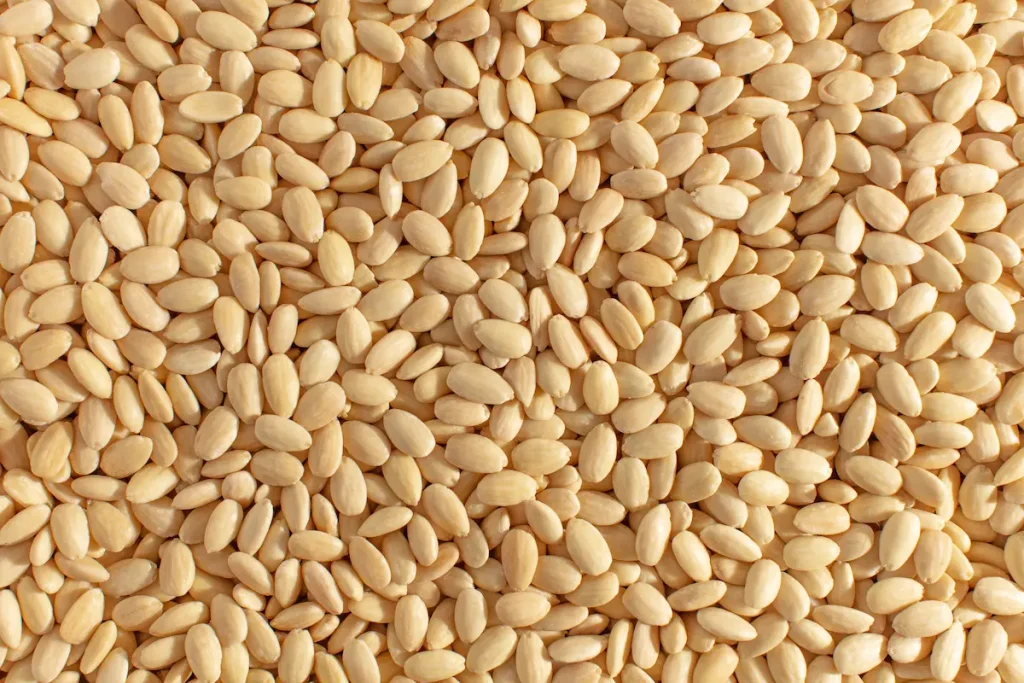
For food manufacturers and industrial buyers, the decision to source whole almonds — rather than other processed formats such as sliced, diced, slivered, halved, almond flour, almond butter, almond oil, or almond protein powder — is both a functional and a commercial one. Whole almonds deliver the strongest visual almond identity of any format, the longest shelf life across the almond product range, and the highest per-unit flexibility, since they can be deployed as-is or further processed in-house. But sourcing whole almonds at industrial scale requires understanding a set of technical specifications that directly affect how the ingredient performs in your production line.
In this article, we cover: what whole almonds mean in an industrial context, including the difference between natural, blanched, roasted, and organic; how AOL sizing and USDA grade classifications work; key specification parameters including moisture, serious damage tolerance, and shelf life; the nutritional profile of whole almonds as an ingredient; which industrial applications and segments are best served by whole almonds; and how Treehouse Almonds delivers supply consistency and quality at scale.
Whole almonds for industrial use are available in four main variants, each defined by its processing stage and cultivation standard. Understanding these distinctions is the starting point for any sourcing decision.
Source: Treehouse Almonds — Whole Almonds Wholesale
Source: Treehouse Almonds — Organic Almonds
Industrial whole almond specifications are expressed in two primary dimensions: AOL size and USDA grade. Understanding both is essential for procurement teams specifying almonds for formulated food applications.
AOL stands for Almonds per Ounce by Length — a standardized sizing system that expresses how many almond kernels fit within one ounce by count. A lower AOL number means larger kernels; a higher number means smaller kernels. Treehouse whole almonds are available from 20/22 (largest commercial sizing) to 36/40 (smaller kernels used in confectionery and inclusion formats).
| AOL Size | Kernel Size | Common Industrial Use |
|---|---|---|
| 20/22 | Very large — ~20–22 kernels per oz | Premium snack, gifting, chocolate bark, high-visibility confection |
| 23/25 | Large — ~23–25 kernels per oz | Snack mixes, energy bars, trail mixes, retail bags |
| 27/30 | Medium-large — ~27–30 kernels per oz | Bakery, confectionery inclusions, snack products |
| 30/32 | Medium — ~30–32 kernels per oz | General confectionery, chocolate coatings, snack applications |
| 34/36 | Medium-small — ~34–36 kernels per oz | Standard confectionery and bakery applications |
| 36/40 | Small — ~36–40 kernels per oz | Chocolate inclusions, compact bar formats, coatings |
USDA grades define quality thresholds for defect tolerance, uniformity, and damage levels. For industrial buyers, the grade directly affects yield consistency and the visual quality of the finished product. Treehouse whole almonds are available across the following key grades:
Source: Treehouse Almonds — Whole Almonds Wholesale Specifications
Source: USDA AMS — Shelled Almonds Grades and Standards
Source: Almond Board of California — Standards and Grades
| Parameter | Specification | Industrial Significance |
|---|---|---|
| Moisture | < 6% (raw); < 3% (roasted) | Controls shelf life and oxidation risk; critical for long-haul supply chains |
| Serious damage | < 2% (SSR/Supreme); < 5% (Standard/W&B) | Defect tolerance that determines usable yield per batch |
| Shelf life — Natural | 24 months | Longest shelf life of any almond format; advantage for inventory-sensitive buyers |
| Shelf life — Blanched | 18 months | Skin removal slightly reduces oxidative stability vs. natural |
| Shelf life — Roasted (vac.) | 12 months | Higher surface oxidation from roasting; vacuum packaging mitigates risk |
| Storage temperature | 35–45°F (2–7°C) | Cold storage required for all formats to achieve stated shelf life |
| Relative humidity | 55–65% | Prevents moisture uptake and subsequent mold or quality degradation |
| GMO status | GMO free | All California almonds are naturally GMO free |
Whole almonds are the tree nut highest in Vitamin E and riboflavin per ounce, according to the Almond Board of California. Per one-ounce serving (approximately 23 kernels), whole almonds deliver:
Source: Almond Board of California — Nutritional Facts
Source: Almond Board of California — Whole Almonds
For manufacturers, this nutritional profile supports a range of label claims — from high-protein and high-fiber to heart-healthy and plant-based — without the need for additional fortification. Almonds remain one of the most recognized and widely used tree nuts across global food categories.
Source: Almond Board of California — Nutritional Facts
A critical specification requirement that affects every industrial buyer sourcing California almonds is mandatory pasteurization. All almonds introduced into commerce in North America are required to undergo a validated pasteurization process under the USDA Almond Pasteurization Program, administered by the Almond Board of California. This program requires a minimum 4-log reduction of Salmonella bacteria, achieved through an approved treatment method validated by an ABC-approved Process Authority.
Depending on the supplier, approved treatment methods include steam pasteurization — which is appropriate for both conventional and organic almonds and preserves the almond’s natural properties — moist heat treatment, and Propylene Oxide (PPO) fumigation, which is approved for conventional almonds only. Buyers sourcing organic whole almonds should confirm that their supplier uses a PPO-free pasteurization method, as PPO treatment is not permitted for organic certification.
For industrial buyers, pasteurization compliance is a non-negotiable supplier qualification criterion. Request documentation of the treatment method used, the validation status of the process, and whether the supplier operates as a USDA-compliant in-house pasteurizer or uses a third-party custom processor listed by the Almond Board of California.
Treehouse Almonds supplies pasteurized whole almonds in full compliance with the USDA Almond Pasteurization Program requirements, using steam pasteurization — an approved PPO-free method suitable for both conventional and organic specifications. Buyers requiring validated food safety documentation, including process authority letters and treatment records, can request these as part of the supplier qualification process.
Source: Almond Board of California — Pasteurization Program
Whole almonds are the format of choice when the kernel must be visible, recognizable, and texturally intact in the finished product. They are not the optimal format for applications requiring uniform size reduction, smooth texture, or ingredient integration — those segments are better served by sliced, diced, or flour formats. The table below maps the primary industrial applications for whole almonds.
| Application | Recommended Format | Why Whole Almonds |
|---|---|---|
| Trail mixes and snack mixes | Natural whole (23/25–27/30) | Visual almond identity is a product feature; natural skin adds rustic appeal and maximizes shelf life |
| Energy and protein bars | Natural or roasted whole (23/25–30/32) | Bold crunch and whole kernel visibility signal ingredient quality; protein halo supports positioning |
| Chocolate bark and chocolate confections | Blanched or natural whole (20/22–27/30) | Blanched for color-neutral embedding; natural for visible, premium inclusions |
| Retail snack bags and gift packs | Natural or roasted whole (20/22–25) | Largest AOL sizes (20/22) command premium presentation in retail and gifting formats |
| Coated confections (dragées, yogurt-coated) | Blanched whole (27/30–34/36) | Smooth, consistent blanched surface allows even coating adhesion across all units |
| Baked goods with visible almond inclusions | Natural or blanched whole (27/30–34/36) | Retains structural integrity through baking; visible in finished product cross-section |
| In-house further processing | Natural whole (unsized/SSR) | Purchased as raw material for slicing, dicing, blanching, or roasting at the manufacturing facility |
Whole almonds offer the longest shelf life and strongest visual identity, but other processed formats serve different functional roles. The decision between whole and processed formats should be driven by application requirements, not unit price.
For a full comparison of almond formats and their application fit, see: Almond Halves, Sliced, Diced or Whole: Which Format is Right for You
Treehouse California Almonds is renowned for providing natural whole almonds to the most discerning food producers in the world — a position built on more than 40 years of grower-partnered supply and advanced processing technology. Whole almonds wholesale specifications cover natural, blanched, dry-roasted, organic, and pasteurized whole almonds, sized from 20/22 to 36/40 AOL, across grades from Extra No. 1 and Supreme to Select Sheller Run and Standard.
Treehouse’s laser-equipped sorting and grading technology provides kernel-level precision that ensures consistent size, length, and weight across supply batches — allowing food producers to be more efficient as they create products using Treehouse whole almonds. Processing takes place in a 400,000+ sq ft sterile-environment, positive-air facility with steam pasteurization and full farm-to-facility traceability. All whole almond products exceed USDA grades and standards.
For manufacturers whose production programs extend beyond whole almonds, Treehouse offers a full range of processed almond formats and ingredients to support every application across the portfolio — including sliced almonds, slivered almonds, diced almonds, almond halves, almond flour, almond butter, almond oil, almond protein powder, and organic almonds. All formats are produced under the same food safety systems, certifications, and quality standards — making Treehouse a single-source almond ingredient partner for manufacturers with complex or multi-format sourcing requirements.
Industrial packaging is available in 25 lb boxes, 50 lb boxes, vacuum-packed 50 lb options, Super Sacks (1,700–2,200 lbs), and Fiber Bins (1,700–2,200 lbs). Certifications include BRC Global Standards, Kosher, Halal, CCOF (organic), Bee Friendly Farming, EcoVadis, and CASP. For full specification details, visit the Treehouse Food Safety & Quality Systems page.
Questions or larger-volume inquiries (> 1,500 lbs): Contact us directly →
Order samples or small quantities (< 1,500 lbs): Visit the Treehouse Online Shop →
Source: Treehouse Almonds — Whole Almonds Wholesale
Source: Treehouse Almonds — Food Safety & Quality Systems
Source: Almond Board of California — Whole Almonds
Source: Almond Board of California — Nutritional Facts
Source: Almond Board of California — Varieties and Forms
Source: Almond Board of California — Shelf Stability and Shelf Life
Source: Almond Board of California — Nutritional Facts


Be in the loop for vital news about the California almond market.
Enjoy 10% off when you order 6 or more